
Fitplan Origins
Founded in 2011 by Landon Hamilton and Cameron Speck, Fitplan launched its fitness creator platform in 2016 and quickly became one of the top-grossing fitness apps in the United States. By the time FitLab acquired the company in 2022, it had more than 3.4 million users worldwide and a roster of more than 50 athletes, coaches, and trainers, including Mike O’Hearn, Michelle Lewin, Rob Gronkowski, Jen Selter, and Alex Rodriguez.
In announcing the acquisition, FitLab co-founder Mike Melby said Fitplan had “paved the way for the fitness creator boom,” while co-founder Brian Kirkbride said FitLab was built to provide “truly holistic, immersive, connected experiences across the fitness continuum.”
More than four years later, Fitplan is the latest FitLab-owned business to come under scrutiny following a series of problems across the company’s portfolio. Hybrid Fitness Media has previously reported on unpaid vendors and canceled or threatened events involving Ragnar; equipment-order and customer-service complaints involving Assault Fitness; the closure of the Nike Studios; and a lawsuit tied to construction work at FitLab’s Nike Studios project.
Hybrid Fitness Media spoke separately with a former Fitplan employee, a Fitplan coach, and an early investor. All three described a business they said declined after FitLab acquired it in 2022.
After The Acquisition
The former employee said Fitplan had once regularly produced new content, signed trainers, and pursued marketing initiatives. After the acquisition, they said, new programs, trainers, hiring, and marketing initiatives increasingly stalled in approval processes and little was put into action.
“We’d have all these amazing options in front of us,” the former employee said. “And then obviously the red tape would be the decision makers… who would just kind of be like, yeah, well, we’ll just keep an eye on that. And like literally nothing could move forward.”
The former employee said Fitplan stopped approving new trainers, hires, tools, and paid marketing initiatives while revenue declined.
“If you had an idea, it had to be a free idea,” they said. “That was the only way you could do anything at all. No hires, no support, cut down on tools.”
They also said payroll delays occurred periodically during their time at the company, estimating that employees missed a scheduled payday roughly once every four to six pay cycles.
The former employee said trainers whose programs generated revenue for Fitplan remain unpaid, including some with substantial outstanding balances. They said many have been reluctant to pursue payment because of the cost of legal action.
A Fitplan coach who began working with the app in 2015 said the company initially paid trainers 70 percent of revenue generated from their programs.
After FitLab acquired Fitplan, the coach said he was presented with a proposed agreement that would have lowered that share to 50 percent while adding new conditions, including required social-media posts identifying trainers as “Fitplan athletes” two to three times per week. He said he refused to sign it despite repeated requests.
The coach said payments slowed significantly after the acquisition and eventually nearly stopped. By the time an attorney sent a letter demanding payment roughly two years ago, he said Fitplan owed him at least 6 figures.
The letter also asked Fitplan to remove the coach’s programs from the app. He said the company did not respond and that users still contact him about Fitplan login problems, even though he no longer has a relationship with the company.
An early Fitplan investor said he has not recovered his investment following the FitLab acquisition. He said investors were presented with terms under which they would receive 25 percent of their original investment, plus interest, followed by the remaining 75 percent the next year. He also said he was initially told FitLab’s acquisition would create a path to repayment or conversion into stock in a larger company, an outcome he said never materialized.
He said the arrangement also involved conversion into FitLab common stock if repayment did not occur. The investor said he has spent nearly $50,000 on legal fees over the past year and a half and does not expect to recover his money.
Fitplan Customers Report Problems
Despite the app remaining available to download and offering a monthly subscription, Fitplan’s Facebook page last posted on July 12, 2024, while its Instagram account, with more than 340,000 followers, last posted on October 10, 2024. Users commenting beneath those posts describe being unable to register, log in, or connect to the app. At least one subscriber said she continued to be charged while locked out by repeated server errors.
In a comment on Fitplan’s final Facebook post, Lucelli Ruiz wrote that she had been unable to access her account for an extended period because each login attempt resulted in a “server error.”
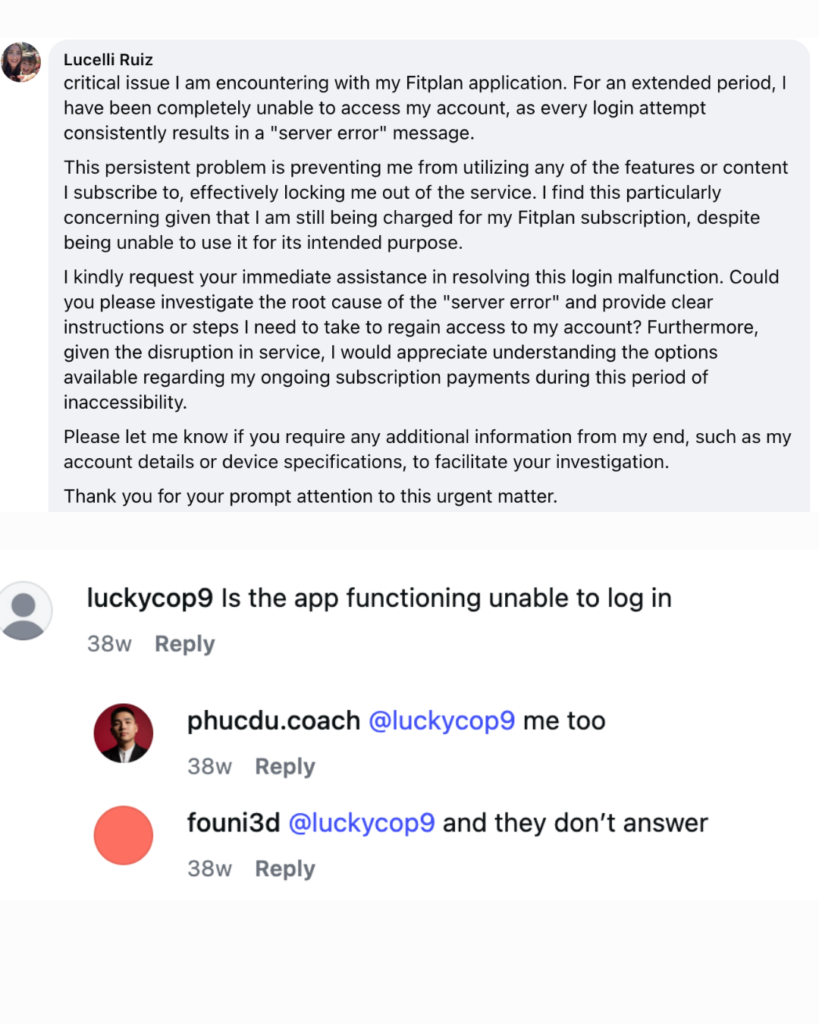
“This persistent problem is preventing me from utilizing any of the features or content I subscribe to,” Ruiz wrote. “I am still being charged for my Fitplan subscription, despite being unable to use it for its intended purpose.”
Comments on Fitplan’s final Instagram posts raise similar concerns. One user said they could not register for a new account. Another asked whether the app was functioning because they could not log in, prompting two users to reply that they were having the same issue.
Hybrid Fitness Media has reached out multiple times in recent weeks to FitLab co-founders Mike Melby and Brian Kirkbride, including for this report, and has not received a response.