

Several elite athletes at HYROX Maastricht voiced frustration with how judging standards were applied, saying unclear communication and penalties had a direct impact on their races. While many competitors completed the event without issue, multiple elites reported decisions that changed their results.
Sean
Sean Noble said he was on for a mid-55 finish in Maastricht before problems began at the Wall Balls.
“I got the first 40 perfect, then 22 no-reps in a row,” Noble said. “I turned around and said, what the hell is going on? I’m not doing 300 wall balls.” He later added that he “lost the head” in the moment.
According to Noble, after the race he spoke with officials who reviewed video and told him the calls were wrong. He said the judge admitted making a mistake, but because he walked off, no adjustment could be made. HYROX has not independently confirmed this account. “I’m racing Hamburg in two weeks,” Noble said. “It was a good performance up until then, but extremely frustrating.”
In footage filmed by a spectator and shared with Hybrid Fitness Media, Noble can be seen performing approximately 92 reps in just over four minutes. The video is linked below. By comparison, his previous five HYROX races show Wall Ball station splits of 3:34, 3:52, 4:12, 3:43, and 3:44.
Another elite athlete said unclear communication with judges had a direct impact on his race.
Jeremy
Jeremy McConnell-Cooke, who was later disqualified for arguing with a judge, said unclear communication left him frustrated. He wrote on Instagram, “Won’t go too much into this one, disqualified for challenging a judge in handing us 4 x10 second penalties on the burpees whilst we were nosing the lead, I made amends with the team after. Felt very sharp and back to myself out there after a few set backs.”
Speaking to Hybrid Fitness Media, McConnell-Cooke added, “To be fair, I think Aitor did stagger a little bit in his burpees, but it was more so like we didn’t get a proper warning. It was just a straight up penalty. Maybe introduce a traffic light system, green number then maybe red. It’s just too hasty.”

He said penalties can have a major impact in a time-based race. “Giving us a 10 second penalty effectively wipes us out,” McConnell-Cooke said. “I understand he probably was leaping a little bit, but you saw with the Wall Balls, it was way over the top and it’s just ruining the sport. Not many people can afford to keep traveling and getting unnecessary penalties. It’s boring at this stage.”
Graham
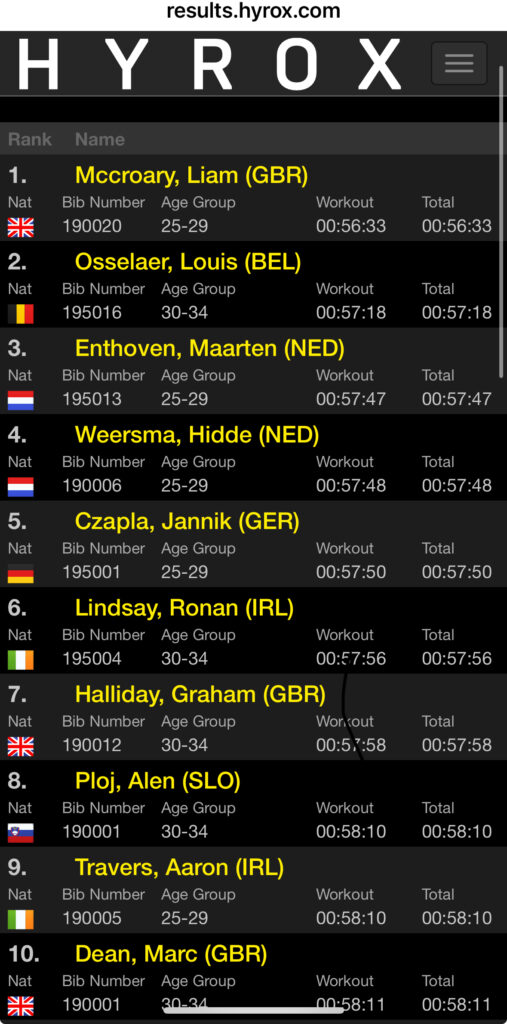
Graham Halliday, who received a 15-second penalty that moved him from third to seventh, also raised concerns about how judging standards were applied and said communication was lacking.
“I didn’t get anyone saying after the first warning. I should have been made aware of my penalty, which I wasn’t,” he said. “My right foot came behind my hand, my left foot comes up behind my right foot (slightly staggered). I gain no advantage as my leading foot is still behind my hand position. And the stagger wasn’t even half a foot difference.”
Halliday added, “I’ve been told two head judges approached me, but only one did. There was never communication about me getting the penalty. I don’t care for my time getting taken off, it’s more about the future of the sport.”
Tanja
An athlete we did not get a quote from but who shared her experience on Instagram was Tanja Stroschneider.
“Leading the race for most of the time, on course for a new PB until the Burpees, my race was over already in the first half,” she said. “I got a total of 2:15 penalty and until now, I don’t know why exactly because I don’t speak Dutch. The first one I obviously got because I stepped on the back line of the sled pull. Then I got two penalties at the BBJ because my feet were not parallel.”
She said the process slowed her even further. “If you get a penalty now, a picture is taken of your forearm with your bib number. With the sweat, my number was gone so every time I had to stop even longer to spell it out.”
Stroschneider added that while she tried to continue, the mental effect was severe. “There was no point anymore to turn things around and nothing to fight for, but I still didn’t want to drop out,” she said. “We are super strict in training with movement standards, and rewatching the videos again and again, I still don’t find any answer for my why.”
She closed by reflecting, “Having character also means to accept what happened and move on. I’ll work on that but this will take a while. Hyrox, I still love you.”
View this post on Instagram
With Noble, McConnell-Cooke, Halliday, and Stroschneider all describing confusion or disagreement with judging in Maastricht, HYROX judging consistency has come under renewed scrutiny. As the sport grows and athletes travel worldwide to compete, athletes are increasingly calling for clearer communication and fair application of standards.
While many athletes completed the event without issue, several elites said their races were significantly affected by judging decisions.
As soon as concerns were raised involving Noble and Halliday, Hybrid Fitness Media reached out to HYROX for clarity on the rulings. Mat Lock, HYROX Technical Director – Elite Racing, was quick to respond, providing updates as he spoke with his team onsite and making sure we had the most accurate information available. When asked about video, he said he was open to reviewing any footage but would not make an official comment.
More HYROX Coverage
- HYROX Hamburg Major: New Rules, Race Times, and Athlete Procedures
- HYROX Cancún 2025 – Schedule, Location, and Racecation Guide
- HYROX Athlete License 2025/26 – What Competitors Need to Know
Podcasts featuring news and interviews from HYROX, DEKA, Deadly Dozen, and the wider hybrid fitness world.
Listen on Apple or Spotify.
Burpee broad jumps are still brutal, but the stricter standards have changed the feel of the movement. Instead of flowing with power and athleticism, athletes are locked into tiny details — exact hand placement, perfectly even feet, no hint of a stagger. The workout is still a fitness test, but the natural explosiveness feels muted by all the technical checkpoints. Easing off the strictness could preserve fairness while still letting the movement shine, so long as athletes aren’t gaining egregious forward progress through big staggers, falling forward, or other obvious shortcuts.